
Stop Asking Donors to Choose: Rethinking Donor Segmentation for Sustainable Growth
I was working with a nonprofit team recently that had been given a capital campaign goal. Leadership had announced a bold fundraising goal. Yet, when I asked what portion of their annual operating budget that covered, the room went silent. Someone finally admitted, “It doesn’t.” After a few quick calculations, we realized their real need was millions higher.
These surprising moments happen far too often. Nonprofits typically run two separate fundraising campaigns: one to keep the lights on and another to fund the future. But donors don’t see the world that way, and neither should we.
The core issue is that many of these campaigns are centered around older concepts of market segmentation. Most donor segmentation strategies still revolve around how much or how often someone gives, or which campaign they give to. While useful labels for budget tracking, they aren’t helpful when it comes to strategy. Rather, when we separate operational and capital goals, we divide our team, our message, and ultimately our results. The truth is that every donor, no matter their capacity or gift size, contributes to the same mission. What changes isn’t what they give to, it’s why they give.
The most damaging fundraising split is the internal split between “keep the lights on” and “build the future,” as if donors can only care about one at a time. Instead, most donors want two truths to be true simultaneously:
My gift helps someone now.
My gift helps ensure this problem is less likely tomorrow.
When we force donors to choose, we create unnecessary friction. We find that teams end up chasing separate goals with competing messages. Boards get confused about what they’re supposed to fundraise for. Donors feel like they’re being asked to fund a gap rather than invest in a vision. As a result, the organization becomes dependent on urgency, even when it’s trying to mature.
The strategy shift: one mission, two invitations
The practical move isn’t to eliminate annual funds or capital campaigns. It’s to stop treating them like separate stories. A stronger approach is to build one shared narrative with two clear invitations inside it:
- Give today to meet the need in front of us.
- Invest in tomorrow to build the conditions that reduce that need over time.
Across campaigns, I see two core donor mindsets that shape nearly every major decision: investment-focused donors and present-focused donors.
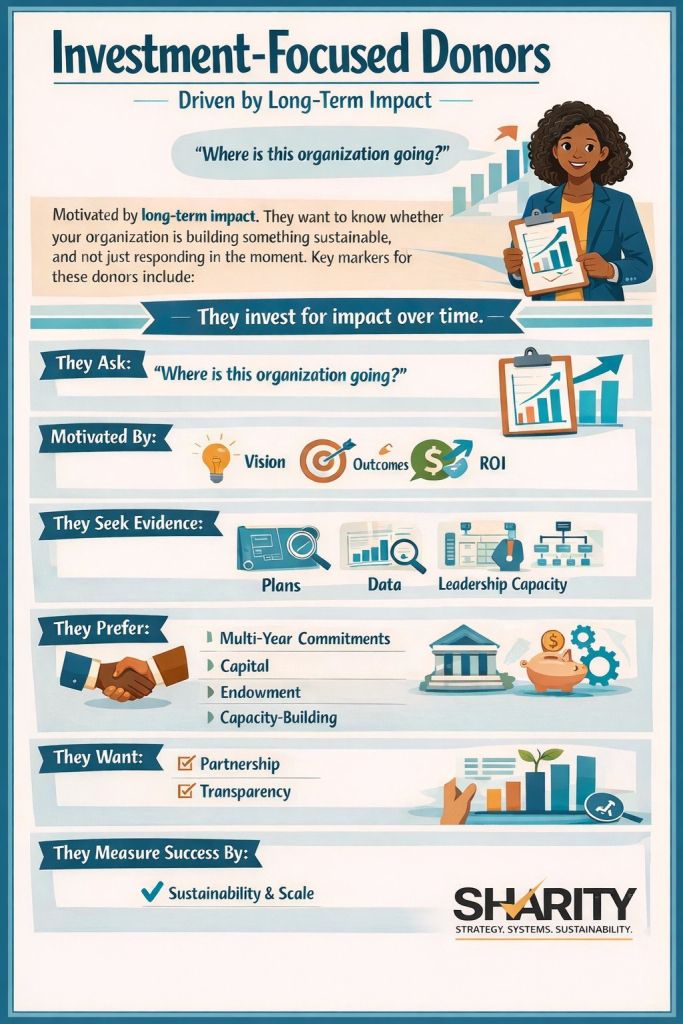
Investment-Focused Donors
Investment-focused donors are motivated by long-term impact. They want to know whether your organization is building something sustainable, and not just responding in the moment. Key markers for these donors include:
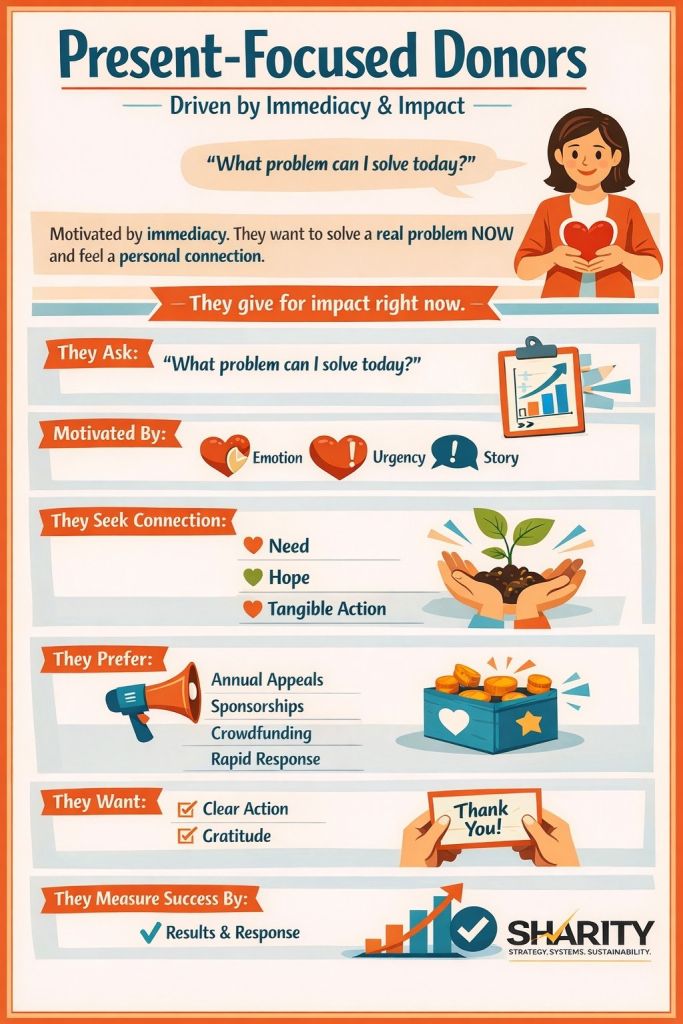
Present-Focused Donors
These donors are motivated by immediacy. They want to solve a real problem now, and they want to feel that connection personally. Key factors include:
A healthy fundraising strategy speaks to both by using emotion to inspire and evidence to reassure. Emotion opens the heart, while credibility keeps it open.
Your present-focused donors should always be able to see the human impact. Your investment-focused donors should always be able to see the system behind the impact. To do this, target your campaigns to these different segments and differentiate your outreach by focusing on presenting compelling stories to present-focused donors, while pulling back the curtain on finances for investment-minded donors. Offer one-on-one consultations with investment-minded donors to discuss mutually beneficial financial arrangements and endowments. Consider behind the scenes tours or unique hands-on volunteer engagements for present-focused donors. These strategies would be housed under your larger fundraising campaign.
What alignment actually looks like
When your strategy, outcomes, budget, team, and donor communications align, you no longer have competing campaigns. You have one integrated vision where donors can give today and invest in tomorrow.
And here’s the payoff: you stop fundraising as if your organization has two identities. You start fundraising like a mature institution that can meet today’s urgency and earn long-term confidence. Sustainability comes from learning to speak fluently to both.
Starting off strong
The way to create alignment comes from creating a donor pipeline, where supporters first discover you, then learn, trust, engage, and finally invest. The pipeline tracks where supporters are in their journey, and helps your organization target which parts of the pipeline may need more fine tuning, and where it excels. The first point of contact is crucial because it is where awareness ideally sparks interest. For a nonprofit, it could be a shared social media post, a colleague invitation to a volunteer event, or a moving news segment about the impact of your organization.
To help improve first contact impressions, you will want to collect data on how new supporters first learn of your organization. It can help identify which sources are most powerful, and which outreach efforts may need to be trimmed or adjusted.
Once the entry funnel has been adjusted for success, you can track supporters through the donor pipeline. The goal is that instead of a “please donate,” the tone will become “here’s what success looks like—will you join us?” The goalis to build a relationship with donors, not beg for charity. Donors feel positively about partnering with an organization where they feel they will make a real and tangible difference.
Restructuring your team for growth
Thankfully this isn’t a call to cull your workforce. Rather, it is gathering the team to reset the mindset regarding your organization and how to gather supporters. Everyone will play a role in conversion, pulling supporters through the pipeline to become donors. How this translates for your organization is to encourage your team to see themselves as part of a seamless donor experience. Receptionists to volunteer coordinators to board members should all consider themselves part of the process of curating donors.
To help ensure the terminology, approach, events and other aspects of your donor pipeline are still resonating with donors, hold quarterly reviews to identify where prospects stall and where messaging or follow-up can be improved. This needs to be a continuous improvement process rather than a series of disconnected campaigns.
The Gentle Art of Qualification
As part of the pipeline process, it is important to undertake the respectful art of qualification. It helps to prevent donors from being asked to make commitments they are unable to honor, and it preserves your staff’s energy. By taking time to learn about your supporters, you can help determine what sort of path they can follow through your organization. For example, some donors belong in the annual program, where consistency and volume matter; others belong in a major-gifts or investment-level journey, where depth and alignment drive success. In other cases, supporters cannot assist financially, but they have the capacity to give time and volunteer.
Most nonprofits skip this step and place all supporters into a single database that is accessed for all calls for funding, big and small. By going through the process of qualification, it ensures that every conversation and touchpoint matches both the donor’s potential and their passion.
There are different methods of qualification, but one powerful tool is the CAP mode, which focuses on:
- capacity (can they give?)
- affinity (do they care about your mission?)
- propensity (are they connected enough to you that they will give to you?)
By combining these three indicators, you can build a donor profile that prioritizes relationships with the highest potential for authentic connection and long-term giving. You stop forcing donors to choose and start building stronger connections with supporters so that you meet them where they are, for long-term successful partnerships. You understand if they are present or investment focused donors and honor their personality and approach to philanthropy.